- The School Run Has Always Been Complicated – Now It’s Changing
- Priority 4: Equitable Access Is Now on the Agenda
- Personal Travel Budgets: What They Mean for Your Family
- What “2026 Compliant” Looks Like for Transport Providers
- June 12th: The Date Worth Putting in Your Diary
- Getting Ready for September 2026
The School Run Has Always Been Complicated – Now It’s Changing
For families with a child who has SEND, the morning school run is rarely straightforward. Wrong vehicle, unfamiliar driver, a route that changes without warning – these are the things that can unravel an entire day before it even starts.
Hackney Council knows this. After three phases of co-production involving over 200 children, young people, parents, carers, and professionals, the borough has published its Hackney SEND and Inclusion 3-year strategy for 2026–2029. Transport sits at the heart of what’s changing.
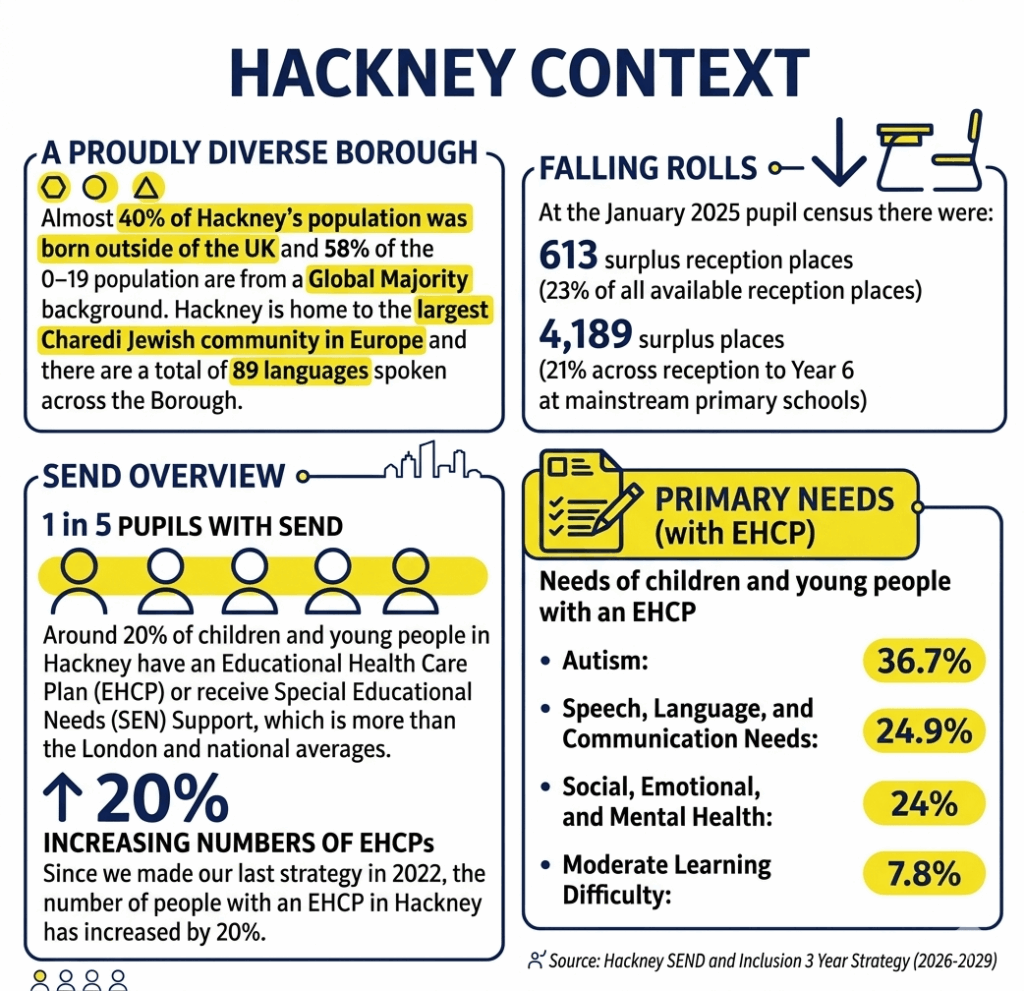
With 1 in 5 pupils with SEND in the borough now requiring SEND support and EHCPs increasing by 20%, understanding this local context shows exactly why an updated approach is so vital.
The strategy replaces the old approach – rigid routes, rotating staff, limited flexibility – with something more focused on the individual child.
That shift has real, practical consequences for how families can arrange the school run from September 2026 onwards.
Priority 4: Equitable Access Is Now on the Agenda
One of the strategy’s five core priorities is “Waiting Times and Equitable Access to Support.” The council is acknowledging outright that past arrangements didn’t work equally well for everyone – particularly children with higher-complexity needs or those transitioning to post-16 education.
The 2026 strategy sets a clear direction: every child, regardless of the nature of their needs, should have a reliable, appropriate way to get to school. Transport planning can’t simply follow the most convenient route for the fleet. It has to start with the child.
This opens real space for specialist private hire operators to step in where standard council routes fall short. Families who previously had limited options may now have more.
Personal Travel Budgets: What They Mean for Your Family
Perhaps the most significant practical change is the push toward Personal Travel Budgets (PTBs). Instead of being assigned to a council-operated vehicle, eligible families receive funding directly – and can use it to arrange transport with a provider they choose and trust.
Children with sensory processing differences or anxiety often do far better with the same driver, the same vehicle, and the same routine every single day. A dedicated private hire partner can offer that. A rotating council fleet generally can’t.
PTBs aren’t available to every family, and eligibility matters. For those who do qualify, though, the shift is real – you choose the provider, you build the relationship, and you’re not starting from scratch every time a new driver turns up.
What “2026 Compliant” Looks Like for Transport Providers
The strategy also raises the bar for anyone working in SEND transport. The direction of travel includes training requirements around neurodiversity awareness, physical support, and emotional co-regulation – not just a valid licence and a clean vehicle.
Hackney is also pushing toward zero-emission school runs as part of its wider environmental commitments. For families working with Personal Travel Budgets, choosing a provider who is moving toward a greener fleet is increasingly relevant both for council approval and for the borough’s air quality.
Enhanced DBS checks and regular vehicle maintenance checks remain the baseline. But the 2026 strategy signals that providers who invest in specialist training will be the ones families and the council can rely on.
June 12th: The Date Worth Putting in Your Diary
On 12 June 2026, Hackney is holding a live Q&A webinar where the detail of the new commissioning model will be outlined. This is where families will get clarity on how PTBs will work in practise, what the eligibility criteria look like, and what providers need to demonstrate.
June is also the month when transport arrangements for the next academic year need to be confirmed. If you’re planning to use a PTB – or are trying to understand whether your child qualifies – this webinar is the right starting point.
The strategy also includes a focus on Independent Travel Training, which supports young people (particularly those approaching or in post-16 education) to build confidence travelling independently.
Transport providers who understand this transition and can support it alongside formal travel training are well placed to help.
Getting Ready for September
For Hackney families, the timeline is tighter than it looks. The new strategy is live, the commissioning framework is being finalised, and the June webinar is the moment to get answers.
If your child has complex needs, anxiety around change, or sensory sensitivities that make shared transport difficult, a dedicated private hire arrangement through a PTB may be worth exploring now – before the September rush.
Find more details here.
Let Jimac Cars provide safe and reliable transport for families and young people with SEND needs, making every journey easier and stress-free.